Why Knowing What to Do Still Doesn’t Change What You Do
TL;DR: Knowing what to do isn’t always enough when the real moment shows up. It helps to have one simple response ready ahead of time, tied to a cue you recognize, and make that response easier to use than the old pattern.
You can make a totally sensible plan at breakfast and still find yourself doing the old familiar thing at 8:47 p.m. The problem isn’t usually that you forgot what you wanted. The problem is that knowing the answer and being able to use it when it counts are two different skills.
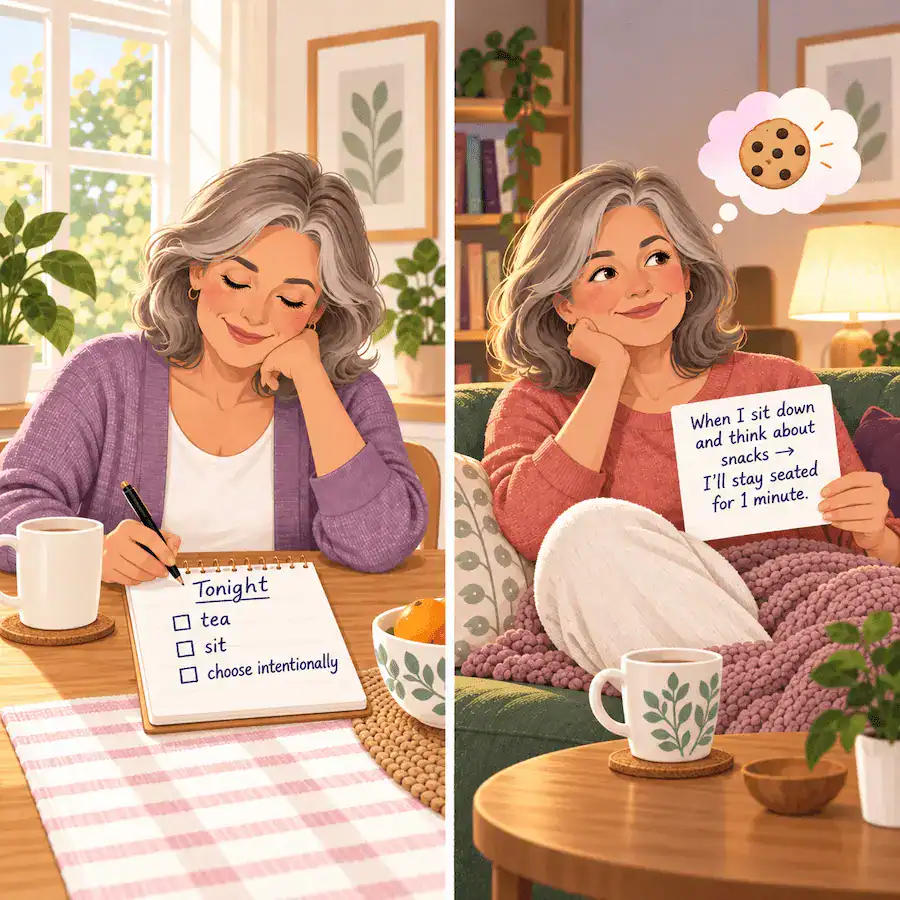
I’ve had plenty of evenings when I remembered exactly what I had planned to do earlier. Then I noticed the familiar pattern starting, and still found the old response much easier than the one I had planned.
That’s one reason I keep coming back to this in my teaching: a plan has to be easy enough to use in real life.
In this post
- Why Knowing What to Do Doesn’t Guarantee Follow-Through
- Why the Real-Life Moment Changes the Equation
- What Makes a Different Response Easier to Use
- How to Prepare Your Response Before You Need It
- FAQ: Knowing What to Do but Not Doing It
{{Link each item to its section anchor}}
Why Knowing What to Do Doesn’t Guarantee Follow-Through
Knowing what to do doesn’t always mean you’ll do it when push comes to shove.
At 9 a.m., you may have a perfectly good plan for the evening. But 9 p.m. is a whole different animal. You’re tired, you’re on the couch, the chips are in the pantry, the wine sounds good. Or you just don’t feel like doing what you planned.
That’s where “I know what to do, so why don’t I do it?” gets frustrating.
Design for the Moment That Actually Trips You Up
Knowing helps. Planning helps. But when the old familiar pattern starts up, you still need something you can actually use right at that moment.
You probably already know you could make tea, have the snack you planned, go for a walk, stop after one glass of wine, or do the workout you meant to do. You don’t need another list of good ideas.
What you DO need is a simple response that’s ready before that moment gets here. That way, you’re not trying to figure it all out while the old pattern is already in the starting gate.
The morning plan matters. But the evening moment is where the pattern gets tested.
I could have told you exactly what the plan was that evening. But when the familiar cue showed up, the old response was already sitting there with its shoes on while the “better” plan was still buried three rooms away.
What Will Be Available to You When It Happens?
That’s important, because it changes what you practice. Instead of spending all your effort making a stronger promise in the morning, you can start designing for the actual moment when the promise will be tested.
If the pattern still feels so automatic that you usually notice it only after it is over, start one step earlier. I break that down in The One Change That Makes Evening Eating Feel Less Automatic. That post is about learning to SEE the sequence. This one starts with the next problem: you can see what’s happening, but the familiar response is still easier to use.
So, the useful question is no longer only, “What should I do?”
It’s now, “What response will actually be available to me when this specific moment shows up?”
Why the Real-Life Moment Changes the Equation
A Morning Plan and an Evening Moment Are Not the Same Thing
One thing we assume all too often is that a plan should work the same way no matter what time of day it is.
But the plan you make at 9 a.m. and the moment you face at 9 p.m. are happening under very different conditions.
By evening, you may be tired. You get settled into the couch and start watching your favorite show. Then comes the thinking about the cookies on the counter, or remembering that the chips are in the pantry. Those familiar situations often come with familiar responses already attached.
A morning plan and an evening moment are not the same thing.
Use the Cue to Trigger the Response
Researchers call one way of planning for this an implementation intention. That’s just a fancy way of saying: “When this happens, I’ll do this.”
For example: “When I sit down to watch TV and start thinking about snacks, I’ll wait one minute before I get up.”
Research on this kind of planning suggests it can help because you’re deciding ahead of time what you’ll do when a familiar situation shows up. An old habit doesn’t disappear just because you made a new plan that morning. By evening, that plan may be much harder to remember or act on.
That doesn’t mean an if-then sentence is some sort of magic spell. The plan works better when you know what moment to watch for and what you’ll do when it happens.
Specific Beats Vague in the Moment
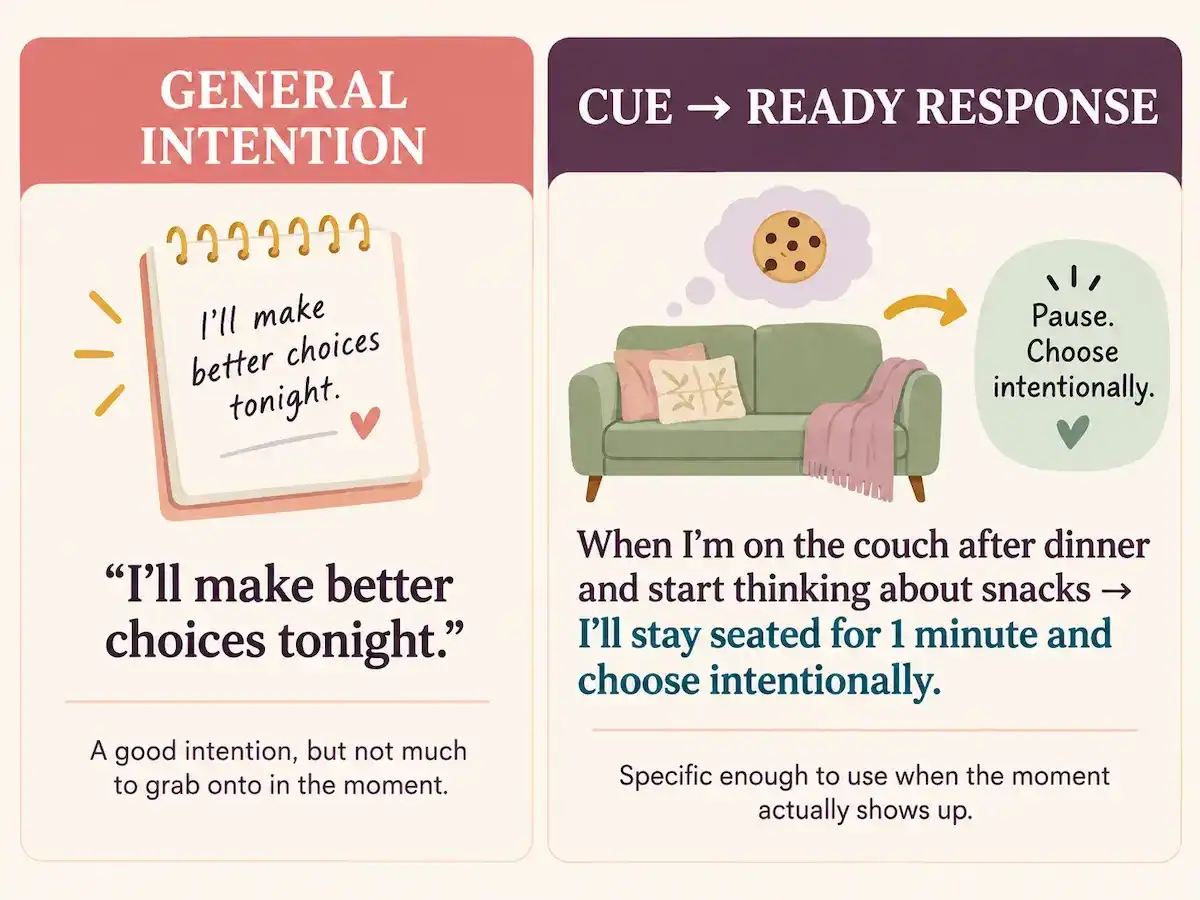
“I’ll make better choices tonight” is an intention.
“When I sit down after dinner and start thinking about something crunchy, I’ll stay seated for one minute and decide what I want before I go to the kitchen” gives you something much more specific to work with.
A useful plan has three parts:
- a moment you’ll recognize
- a response you’ve already chosen
- a setup that makes that response easier
The goal isn’t to predict every possible urge. It’s to make one familiar moment easier because you already have a response ready instead of trying to figure one out on the spot.
You may still want the thing, and it may still take some effort to choose differently. But if you’ve already decided what you’ll do when that familiar cue shows up, you don’t have to solve the whole problem in the moment.
And you don’t need an elaborate rulebook for every possible evening. Pick the moments that repeat. Those are the ones worth preparing for.
What Makes a Different Response Easier to Use
A different response gets easier when three things are true: you know what to watch for, you already know what you’ll do, and you haven’t made that response harder than it needs to be.
Start With a Cue You Can Actually Recognize
Start with the cue. Make it specific enough that you’ll actually recognize it when it happens.
“When I struggle” is too vague.
“When I sit on the couch after dinner and start wondering what’s in the pantry” gives you something you can spot.
Make the Response Small Enough to Use
Then choose a response small enough to do without launching a committee meeting in your head. You’re not trying to solve the rest of your life. You’re deciding what you’ll do for the next thirty seconds, one minute, or five minutes.
Maybe you stay seated for one minute. Maybe you drink the tea you already made. Or, maybe you put on your walking shoes, open the reminder on your phone, or ask yourself one simple question before you move.
Change the Friction Around the Choice
Then look at friction.
If the response you want takes six steps and the old response takes one, guess which one is probably going to win more often.
Make the choice you want easier to reach, and the old pattern a little harder to fall into.
That’s where friction can help. Make the old pattern a little less easy, and make the response you want to practice a little easier.
- If your planned snack is hidden in the back of the refrigerator while the chips are sitting open on the counter, change the setup.
- If the reminder you want to use is buried inside a workbook, put the one-line version on your phone or somewhere you’ll actually see it.
- If a walk means finding shoes, socks, headphones, and a jacket, get those things ready before the Couch Negotiator starts making its case.
I think of friction as the little steps between you and what you’re about to do. I want a few more steps in front of the old automatic response and a few fewer in front of the choice I want to make easier.
This is where “I know what to do” gets more practical.
The question isn’t whether you know the answer. The question is whether you’ve made that answer easy enough to use when the moment actually shows up.
How to Prepare Your Response Before You Need It
Practice One Repeating Moment
Don’t try to prepare for every possible situation this week. Pick one moment that comes up often enough for you to practice.
Decide what you want to do when you notice it, then make one small change that makes that response easier.
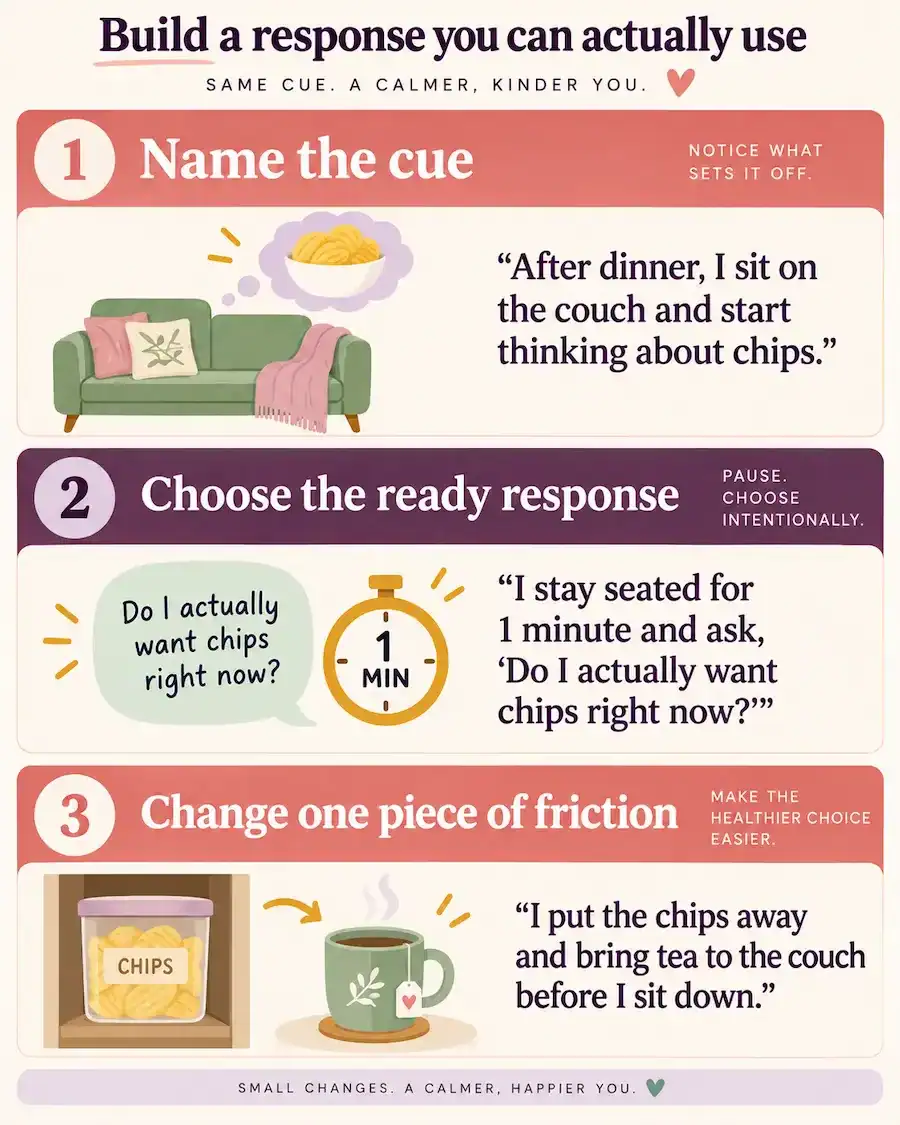
For example, say dinner is over, you sit down to watch a show, and twenty minutes later you start thinking about chips. Your plan might look like this:
- Cue: I’m on the couch after dinner and start thinking about chips.
- Ready response: I’ll stay seated for one minute and ask, “Do I actually want chips right now, or did the usual sequence just start?”
- Friction adjustment: I’ll keep the chips put away and bring my tea to the couch before I sit down.
None of this means you have to stop wanting the chips. It doesn’t mean you’re promising never to eat them. And it doesn’t mean every time you use your response, you’ll make the choice you hoped you would.
Use What Happens as Information
What you’re practicing is having something ready when the familiar moment shows up.
That gives you a lot more to work with than asking, “Was I good tonight?”
Instead, you can ask:
- Did I notice the cue?
- Did I remember what I planned to do?
- Was the response simple enough?
- Did my setup make it easier, or did I accidentally make the old choice easier?
I’ve learned that a response I can remember and do in ten seconds is a lot more useful than a brilliant plan I can’t find once the negotiation has already started.

Adjust the Plan Instead of Starting Over
And if it didn’t work the way you expected, change something.
Maybe the cue was too vague. Maybe the response had too many steps. Maybe the chips, the couch, or that particular time of day has a stronger pull than you realized.
That’s useful information. You can adjust from there instead of turning it into another Monday reset.
And if you’re thinking, “Okay, I can see the moment now, but I still need something practical to do when it happens,” that’s exactly what The PAUSE Plan is built for.
The PAUSE Plan helps you slow down the familiar sequence and decide what you want to do next.
If you’re not ready for that, start with the Stay With It Starter Kit and practice one cue, one ready response, and one friction change this week.
FAQ: Knowing What to Do but Not Doing It
Want to remember this post? Save it to your favorite Pinterest board!