Why Change Feels So Hard (And What You Can Do About It)
Have you ever gotten excited about a new goal—something that felt right in your gut—only to find yourself completely stalling out?
You tell yourself you’ll start Monday (for real this time).
You make the plan. Set the intention. Visualize the outcome.
But somehow… you still don’t follow through.
There’s nothing wrong with you. And you’re definitely not lacking willpower.
What you are running into is your brain’s very smart, very ancient wiring.
This post contains affiliate links. For more information, see my disclosures here.

Your Brain Is an Energy Miser (And It’s Not Personal)
Here’s something that might surprise you:
Your brain uses about 20% of your body’s energy, and yet it can’t store fuel the way your muscles or liver can. That means it’s constantly budgeting how much energy it has and where it’s going to spend it.
And when it comes to change?
That’s expensive.
Your brain’s first priority is survival, not transformation. So it has a default setting that says:
“If it’s familiar, it’s safe. If it’s unfamiliar, it’s a risk.”
Even if the change you want is healthy, exciting, and meaningful…
Your brain still sees it as a potential energy drain.
And its protective instinct kicks in, often without you even realizing it.
So instead of confidently stepping into that new goal, you find yourself:
- 🕓 Putting it off (“I’ll start Monday… again.”)
- 📱 Distracting yourself with other tasks
- 😴 Feeling weirdly tired just thinking about it
- ❌ Talking yourself out of it completely
Sound familiar?
Fear Makes It Worse (Even If the Danger Is All in Your Head)
Now let’s add another layer: fear.
Maybe it’s fear of judgment (hello, recording a video).
Maybe it’s fear of failure. Or fear of change itself.
When fear enters the chat, your brain doesn’t just whisper “let’s take it easy.”
It starts flashing warning lights and pulling you back to what’s familiar—even if that familiar place isn’t serving you anymore.
And that’s when we start repeating old patterns:
- ✖️Comfort eating
- 🙈Skipping workouts
- 😬Avoiding visibility
- 🔙Second-guessing ourselves
Practice Makes a New Response More Familiar

When you’ve done something one way for a long time, the old response can show up before you’ve had much time to think about it. You sit down after dinner and head for the pantry, or you miss a walk and immediately decide the week is shot.
That doesn’t mean you can’t do something different. It means the new response may need some practice before it feels as familiar as the old one.
Thinking about what you want can help you get clear on your goal. Journaling, visualization, or a reminder on your phone might help you prepare. But it’s also useful to practice the action itself, especially in the kind of situation where you usually get stuck.
For example, if your usual response to missing a workout is to write off the week, you might practice asking, “What could I still do today?” Sometimes the answer might be a five-minute walk. Sometimes it might be making a specific plan for tomorrow.
Repeating a behavior in a familiar situation can help it become more automatic over time. That doesn’t mean every day will feel easy or that resistance will disappear. It does mean you’re giving yourself opportunities to practice a different response and learn what helps you follow through.
You’re Not Doing It Wrong—You’re Just Rewiring
If you’ve ever thought:
“Why is this so hard? I know what to do!”
…it’s not because you’re incapable.
It’s because you’re interrupting decades of mental default settings.
You are literally rewiring your brain to see a new identity, a new habit, a new possibility as normal.
And that takes reps.
That’s why the same mindset work might feel boring.
That’s why fear shows up even when the path makes sense.
That’s why change feels like walking uphill at first.
With practice, some parts of the process may get easier or feel more familiar. Other days, you might still have to work at it. Either way, you can notice what’s happening, adjust your approach, and keep practicing.

🌟Let Your Brain Catch Up to Your Desire
So here’s your takeaway:
- 🧠 You’re not failing; you’re rewiring
- 🌿 Repetition teaches your brain a new normal
- 🕊️ There’s no deadline for becoming the woman you envision
- ✨ Your job isn’t to force change, it’s to familiarize it
- 🚶♀️ Keep going. Resistance can show up when you’re trying something different. You can practice your next move even when it’s there.
- 🚫You definitely don’t need to “just get over” your fear.
What you need is a strategy that gives your brain enough repetition to feel safe.
One thought shift at a time. One rep at a time.
So if you’ve ever caught yourself wondering why change feels so hard—guess what? It’s not because you’re broken. It’s because your brain’s out here trying to coupon-clip energy like it’s 1992. But you’re onto it now—and with a few reps and some well-placed stubbornness, you’re gonna show that brain who’s boss. 🧠💪✨
And if you’re not sure where to begin?
👇I made something for that.👇
Make a plan for the moment change feels hard
Maybe you’ve planned to walk, but by the time lunch is over, the couch is calling. Or you miss one workout and catch yourself thinking you’ll just start fresh next week.
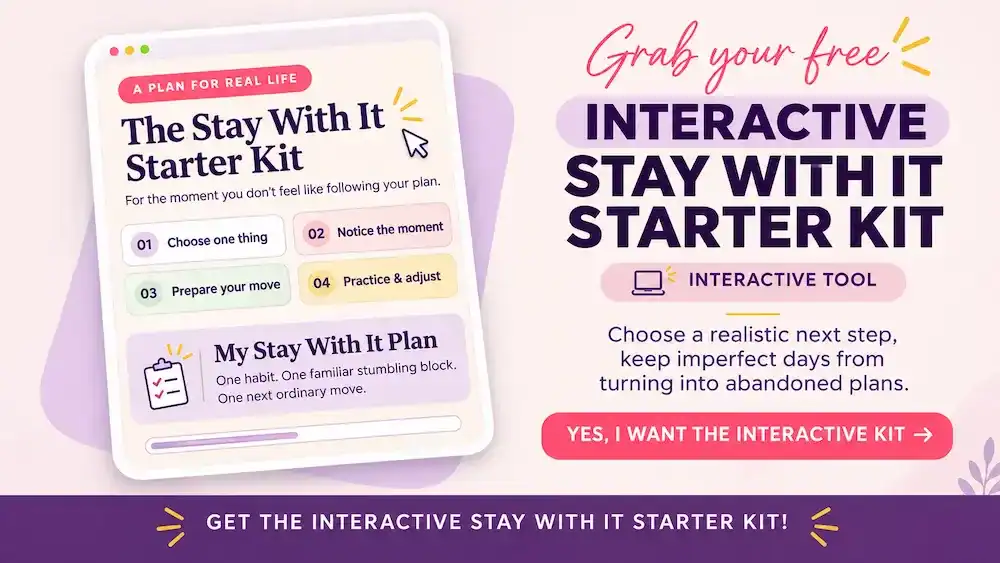
The free Stay With It Starter Kit helps you get specific about those moments. You’ll choose one habit, identify where you tend to lose the thread, and prepare a small, practical next move. By the end, you’ll have your own Stay With It Plan, plus an optional practice log to see what works and what you might want to adjust.
Get the Free Stay With It Starter Kit
You’re not failing. You’re just rewiring.
And you’re doing an incredible job. 💜
Change isn’t hard because we’re lazy or lack discipline — it’s hard because our brains love what’s familiar.
That’s exactly what we’re unpacking inside the Stop Starting Over Women 50+ Mindset + Habits community. 👇