You Didn’t Fall Off the [Fitness] Wagon—It Was Never Going Anywhere Without You
Let’s get one thing straight right off the bat: there is no wagon. There’s nothing to fall off.
That mythical, magical ride where you finally get your act together: eating clean, moving daily, saying no to carbs and yes to kale, all while humming with motivation and wearing matching workout sets? Yeah. That’s not real.
And more importantly: you didn’t fall off it. You had a day, or a week, when things didn’t go the way you planned.
What happened next probably had less to do with the missed workout or unplanned meal than with what you decided it meant.
Because that’s often when a small interruption turns into another Monday restart.
Let’s talk about why that “falling off the wagon” mindset is not only bogus, but the very thing keeping so many women, especially over 50, stuck in a cycle of shame, guilt, and start-overs that never seem to stick.

🚫 The Wagon Mentality: Who Built This Thing, Anyway?
Somewhere along the way, we were sold the idea that fitness and health are like a ride: you either get on, white-knuckle it through salads and squats, or you fall off the second life gets lifey. (You know, like when your back flares up, your grandkids come to stay, your job gets chaotic, or you just want a damn cookie.)
But here’s the thing:
There is no wagon. There’s your actual life, the habits you’re practicing, and the decisions you make when things don’t go as planned.
And those decisions don’t stop counting just because yesterday was a mess.
This “on or off” thinking is seductive. It makes it feel like you’re doing something right…until you’re not. And then it becomes a bat you beat yourself with:
- “I was doing so well until that vacation…”
- “I just need to get back on track.”
- “Why can’t I stay consistent like everyone else?”
Girl. Everyone is figuring it out. And consistency doesn’t mean perfection.
🔄 Real Talk: The “Start Over” Spiral Is a Trap

Let’s break down the cycle so many of us know way too well:
- You start strong – new plan, new journal, new leggings. Hope is high.
- Something disrupts the routine – illness, stress, exhaustion, life.
- You miss a few days – and suddenly, it’s “I blew it.”
- Cue guilt and all-or-nothing panic – “I’ll restart Monday.”
- Repeat. For years.
Sound familiar?
Notice something about that sequence. The interruption isn’t necessarily what sends you back to Monday.
It’s what happens after the interruption.
You miss Tuesday’s workout. That’s one event. Then comes the verdict: “See? I knew I wouldn’t stick with it.”
And once you’ve decided you’ve already failed, Wednesday’s workout starts looking optional, too.
The missed workout didn’t require a restart. The story you attached to it made restarting seem necessary.
That’s the part we can learn to interrupt, not by pretending the missed workout didn’t happen, but by separating what happened from what you made it mean about yourself.
✨ What If There’s Nothing to Fall Off?
Let me offer you this: Your body isn’t a project. Your health isn’t a trend. And your worth isn’t tied to your last workout.
The idea that you have to be perfect to make progress? Lie. The belief that one off week erases everything? Lie. The notion that you “just can’t stick to anything”? Flat-out lie.
Here’s what’s true:
- Progress is never linear. You don’t need streaks, you need patterns.
- Rest days aren’t backslides. They’re strategy.
- A handful of chips doesn’t undo your walk, your water, or your worth.
Consistency doesn’t mean every week looks the same.
Sometimes it means doing the workout you planned. Sometimes it means making the workout smaller because your day got complicated. And sometimes it means missing the workout, noticing what happened, and getting back to it without declaring the week a loss.
The skill isn’t avoiding every interruption. It’s learning how to recover without turning the interruption into a reason to stop.
And every time you practice that, you’re collecting evidence that you can handle an imperfect day without having to start over..
❤️ Especially for Women Over 50…

By this point in life, you’ve probably had plenty of experience with plans that looked terrific on paper and didn’t hold up quite so well in practice.
And there are real considerations now. Hormonal changes can affect sleep and body composition. Strength, mobility, and recovery deserve attention. Your health circumstances and responsibilities may be different from what they were twenty years ago.
But there’s another advantage to having lived a few decades.
You have plenty of information about yourself.
You probably know which routines tend to fall apart when you’re tired, what happens when your schedule changes, and which promises you’ve made to yourself a hundred times.
Instead of using that history as evidence that you’ll never change, what if you started treating it as information?
You don’t need to ignore what happened before. You can use what you’ve learned to make your next attempt more realistic.
So…What Do You Do When You Think You’ve Fallen Off?
Let’s say you planned to walk four days this week.
Monday went fine. Tuesday got away from you. Wednesday you were exhausted, and now you’re thinking, “Well, this week is shot. I’ll start again Monday.”
Before you write off the rest of the week, try three things.
1. Name what actually happened.
“I missed two walks.” That’s the event. Not “I’m hopeless at consistency” or “I always ruin everything.”
2. Notice the story you’re adding.
“This week is ruined.” Is that a fact? Or is it the familiar conclusion your mind jumps to when something doesn’t go according to plan?
3. Choose your next ordinary move.
Maybe you walk tomorrow. Maybe you take ten minutes after dinner tonight. Maybe you look at why Tuesday and Wednesday didn’t work and make a better plan for next week.
You don’t have to make up for the missed walks, punish yourself with a harder workout, or wait until Monday to start fresh. You can simply continue.
And the next time life interrupts your plan, you’ll have another opportunity to practice recovering without starting over.
There was never a wagon to fall off. There was a plan, something happened, and now you get to decide what comes next.
Ready to Practice Staying With It?
It’s easy to tell yourself you’ll do better next time, but what will you actually do when next time arrives and your old pattern shows up again?
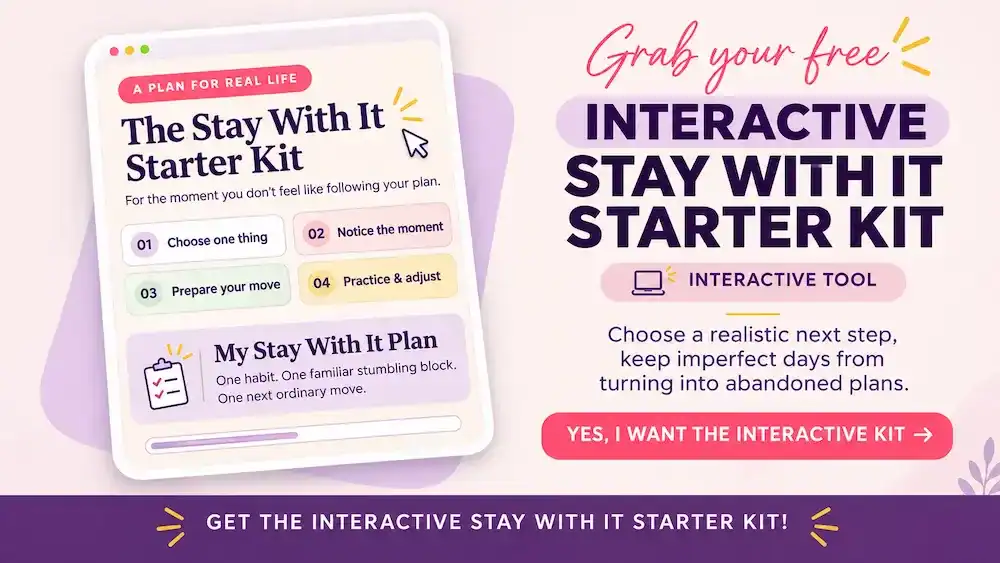
That’s what my free Stay With It Starter Kit helps you figure out.
It’s an interactive tool where you’ll choose one habit you want to practice, recognize the moment you’re most likely to get sidetracked, and build a realistic plan for what to do next.
You can use it when you’re starting something new, or when you’re trying to pick up where you left off.
GET THE FREE STAY WITH IT STARTER KIT
And if you’d like to practice with other women who are learning how to stop starting over, join us inside Stop Starting Over Women 50+. We work with the everyday moments that make consistency difficult, and practice finding a way forward without turning every setback into a fresh start.