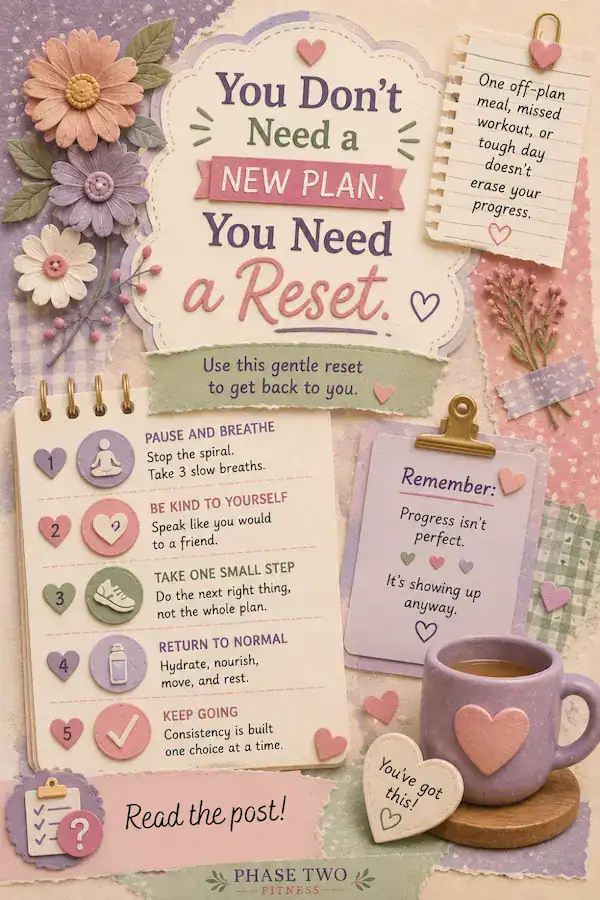
How to Recover After an Off-Plan Meal Without Starting Over Again
You went out for dinner.
Maybe you had the burger instead of the grilled chicken. Or the bread basket kept making its way back around. Maybe you ordered dessert because everyone else did, or because you wanted it, or because by that point you had already decided the night was “off plan” anyway.
Then the meal ends.
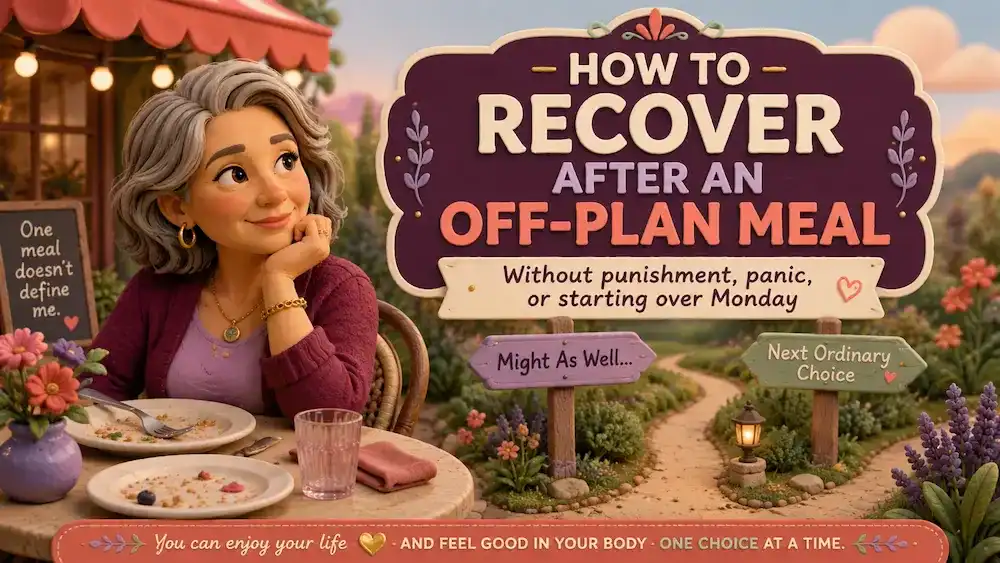
And almost immediately, the mental cleanup begins.
“I blew it.”
“I shouldn’t have eaten that much.”
“I have no self-control.”
“I’ll eat really light tomorrow.”
“I might as well enjoy the rest of the weekend and start over Monday.”
Sound familiar?
For many of us, the meal itself isn’t what causes the most damage, it’s what happens next.
One meal turns into a judgment. The judgment turns into discouragement. The discouragement turns into permission to keep going. And before long, one dinner has somehow turned into three days of eating like the whole weekend was already shot, avoiding the scale, and promising yourself that next Monday will be different.
Again.
So let’s talk about how to recover after an off-plan meal without punishment, panic, or another trip through the start-over cycle.
Because recovery isn’t about erasing the meal, it’s about refusing the let one meal decide what happens next.
First, What Does “Off Plan” Actually Mean?
Before we keep going, let’s clear something up.
An off-plan meal isn’t automatically a bad meal. Maybe it was a restaurant meal or your birthday, or you had pizza with your family instead of the dinner you’d written on your meal plan. Maybe you ate more than you intended, or had dessert because you just wanted dessert.
None of those things automatically means something’s wrong.
Sometimes “off plan” just means life happened outside the little box you drew around it. 📦
Sometimes, yes, you may look back and think:
“That was more than I wanted.”
“I wasn’t even enjoying it by the end.”
“I went into screw-it mode.”
“I kept eating because I thought the day was already ruined.”
That’s useful information.
But information isn’t the same thing as a verdict.
The Meal’s Over. The Story’s Just Getting Started.
Imagine two women have the exact same dinner.
They both go out for Mexican food, eat chips before the meal, order something richer than they normally would, and have dessert.
The first woman thinks:
“That was SO good! I’m really full. I’ll go back to my normal routine tomorrow.”
The second woman thinks:
“I can’t believe I did that. I have no discipline, and now I’ve ruined the week. Oh well, I might as well eat whatever I want tonight and get serious again Monday.”
Same meal. Completely different aftermath.
The meal didn’t decide what happened next. The story did.
This is where so many of us get trapped. We think the problem is that we ate the chips, ordered dessert, or went over our calorie target. But the bigger problem is usually the meaning we attach to it.
One meal turns into proof that you can’t be trusted, you always fail, and that you’re never gonna change.
Once that meal is evidence against you, it’s much harder to make a realistic, helpful next choice. You’re not responding to dinner anymore. You’re responding to an identity verdict.
Step One: State What Happened Without Turning It Into Who You Are
After an off-plan meal, try describing what happened as plainly as possible.
Not:
“I was terrible.”
“I completely blew it.”
“I have no control around food.”
Try:
“I ate more than I planned at dinner.” Or, “I had chips, an entrée, and dessert, and I’m more full than I wanted to be.” Or, “I went into the meal very hungry, and once I started eating, I didn’t slow down.”
Those statements might not feel super comforting, and that’s okay. The goal isn’t to make the meal sound like the best ever, it’s to tell the truth without adding an unnecessary attack.
➡️ This isn’t letting yourself off the hook. It’s being accurate.
Facts give you something to work with. Verdicts shut the whole conversation down. If you tell yourself, “I ate more than I intended,” you can get curious about what happened. If you tell yourself, “I’m hopeless,” there’s nowhere useful to go.
One describes an event. The other describes an identity.
Those aren’t the same thing.
Step Two: Don’t Turn Tomorrow Into a Punishment Plan
The morning after an off-plan meal, we immediately start calculating.
⭕ “I’ll skip breakfast.”
⭕ “I’ll only eat salad today.”
⭕ “I need to burn this off.”
⭕ “I’ll add an extra workout.”
⭕ “I have to make up for yesterday.”
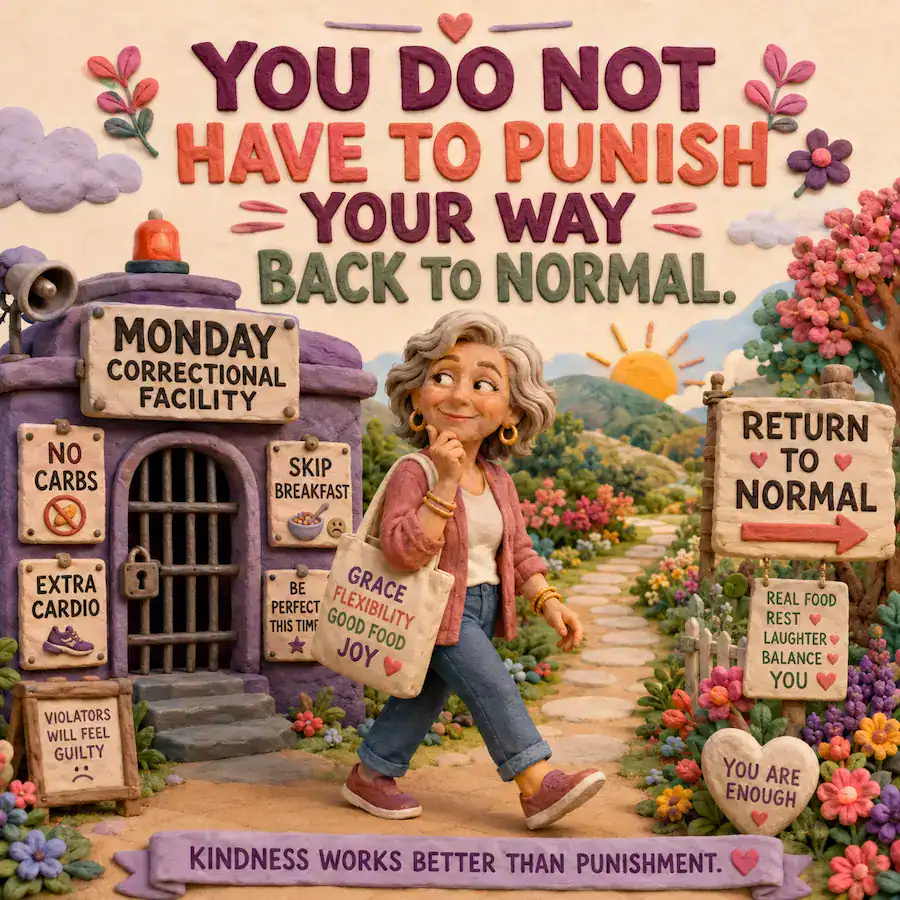
It can even feel disciplined, but more often, it’s just guilt wearing workout clothes.
You’re not calmly deciding what would support you today. You’re trying to erase yesterday, and that creates another problem.
You eat too little, get overly hungry, and spend the day thinking about food and feeling deprived. By evening, your body and brain are both asking for relief.
Then comes another overeating episode, and you take it as more evidence that you can’t stay consistent.
Now you’re stuck in the same cycle: overeat, restrict, get too hungry, overeat again, feel guilty, and start over.
That’s not recovery. It’s punishment followed by rebound.
You don’t need to earn your way back to normal eating. You can just return to it.
Your Next Meal Doesn’t Need to Be Perfect
This is where we so often make recovery so much harder than it needs to be. We think our next meal has to be especially healthy to cancel out the last one.
Now breakfast has to be perfect. Lunch has to be tiny. Dinner has to prove you’re back in control.
That’s a lot of pressure to put on a bowl of oatmeal.
What if the next meal could just be normal? Not corrective, impressive, or some kind of performance. Just a regular meal that supports you.
Maybe it includes protein, fruit, vegetables, whole grains, or whatever normally helps you feel satisfied and steady. Not because you’re trying to fix yourself, but because you’re continuing to take care of yourself.
There’s a big difference.
You don’t need a dramatic reset. You need a return.
And the best time to return isn’t Monday morning. It’s the next ordinary opportunity.
The “Might as Well” Thought Is Where One Meal Becomes a Whole Weekend
You’ve probably heard some version of this in your own head:
- “I already had the burger and fries, so I might as well have dessert.”
- “I already went over my calories, so today is shot.”
- “I already blew dinner, so I might as well keep snacking tonight.”
- “I’ll enjoy the rest of the weekend and start fresh Monday.”
This thought can sound logical when you’re in it. But step back for a second: how does eating more because you already ate more improve anything?
It doesn’t.
The thought isn’t really about logic. It’s about relief.
Once you’ve decided the day is ruined, you don’t have to keep making decisions. You can stop trying, stop feeling conflicted, give yourself temporary permission to do whatever you want, and hand the responsibility to Monday.
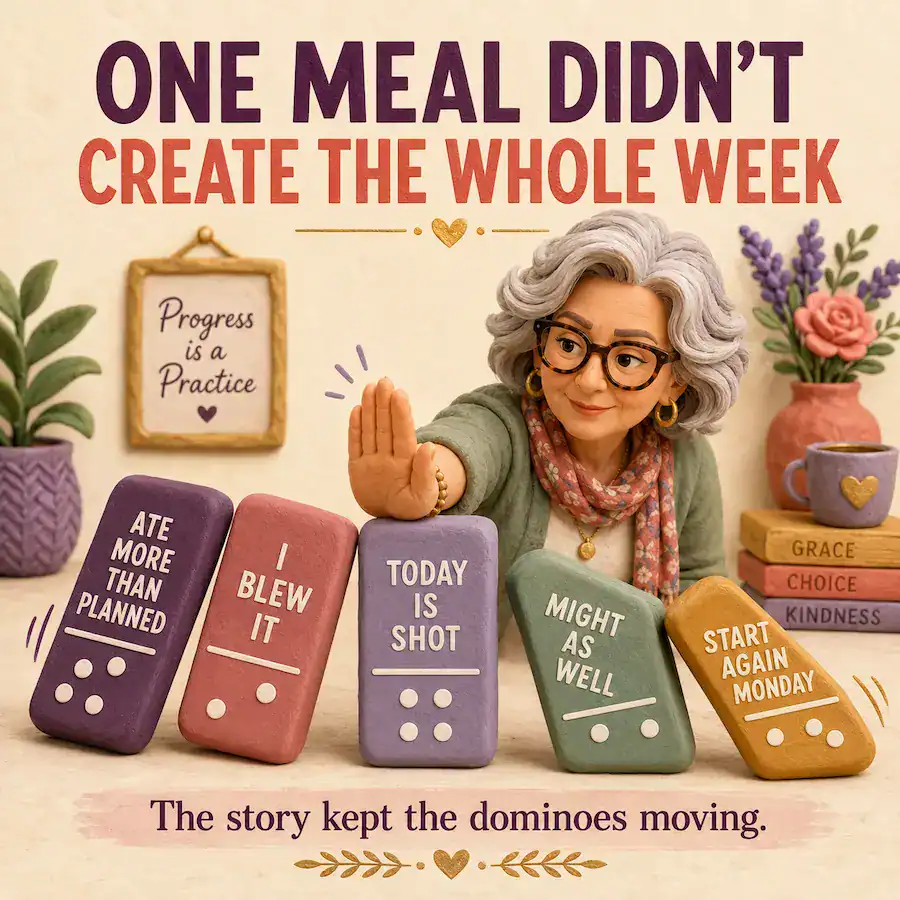
For a little while, that can feel good. The pressure is off.
But there’s a price, because Monday eventually arrives carrying all the promises from the weekend. Now you have to be extra disciplined, extra motivated, and extra perfect. Then the whole cycle begins again.
The next time you hear “might as well,” pause long enough to finish the sentence honestly:
“I already ate more than I planned, so I might as well…”
What?
Eat until I feel worse? Turn one meal into the whole day? Give this dinner control over tomorrow too?
You’re allowed to stop. Not because stopping makes the meal disappear, but because continuing is still a choice.
Ask What Happened, But Don’t Put Yourself on Trial
There is another extreme worth talking about.
Sometimes, in an effort to avoid shame, we rush too quickly into:
“No big deal!”
“Just move on!”
“Forget about it!”
And sometimes that is exactly what is needed.
Maybe you had a lovely meal, ate more than usual, and there’s nothing deeper to investigate.
But sometimes there is useful information in what happened.
Moving on doesn’t have to mean throwing away the evidence.
You can be curious without becoming critical.
Looking back at what happened can help you notice patterns, such as arriving overly hungry, eating in response to stress, or slipping into autopilot.
CURIOSITY CHECK-IN
You don’t need to answer every question. Start with the one that catches your attention.
▸Was I very hungry when I arrived?
▸Did I skip meals earlier because I knew I was eating out?
▸Was I trying to “be good” all day?
▸Did I eat quickly?
▸Was I still enjoying the food, or had I shifted into autopilot?
▸Did I decide the meal was ruined after the first unplanned choice?
▸Was I stressed, tired, lonely, disappointed, or looking for relief?
▸Did this feel like my last chance to eat these foods before getting serious again?
You aren’t building a case against yourself. You’re looking for a useful clue.
The purpose isn’t to cross-examine yourself, it’s to learn something. Maybe the meal shows you that arriving ravenous makes intentional choices much harder.
Maybe you notice that the first few bites were enjoyable, but the rest happened on autopilot, or you realize the biggest turning point wasn’t dessert, but the moment you thought:
“Well, I already blew it.”
That’s valuable.
Not because you failed, but because now you can see the part of the pattern that may need support.
One Off-Plan Meal Doesn’t Require an Entire New Plan
We often respond to one difficult meal by rebuilding everything:
🔷 A new calorie target
🔷 A new meal plan
🔷 No sugar
🔷 No eating after 7:00
🔷 Six workouts this week
🔷 A brand-new tracking app
🔷 A stricter Monday
We do this because the new plan creates a sense of control, and it feels productive. But a lot of times the plan itself wasn’t the problem.
It may have been a perfectly reasonable plan. The problem might have started when you were tired, hungry, disappointed, surrounded by food, or already telling yourself the day no longer counted.
A stricter plan won’t automatically solve that. In fact, the more rigid the plan becomes, the more likely one deviation is to make you feel like a failure.
So, before rewriting your entire life, ask:
“What does this one meal actually tell me?”
Maybe it tells you to eat a more substantial lunch before going out. Or to decide ahead of time what matters most to you at the meal.
Maybe it tells you restaurant bread wasn’t really the problem. It was arriving hungry and mentally labeling the meal a “cheat” that had much more to do with what happened next.
Or maybe it tells you that what you need is practice stopping in the middle, not another list of rules.
Make the adjustment fit the actual problem.
Don’t build a whole new system because of one dinner.
What Recovery Actually Looks Like

Recovery after an off-plan meal can look surprisingly ordinary.
You wake up, notice the urge to criticize yourself, and choose not to turn the meal into proof that you failed. Then you eat breakfast, go for your usual walk, drink some water, and think briefly about what you want to remember from the experience.
After that, you continue with your day.
No cleanse. No punishment workout. No waiting until Monday. No dramatic declaration that this time will be different.
Just continuation.
That may not feel big enough because we’ve been trained to believe change needs to be dramatic. We expect a fresh start, a complete reset, and a bold new promise.
But learning how to just continue after a less-than-awesome choice just might be one of the most important skills you can build. Life will always include meals that don’t go exactly as planned. There will be birthdays, vacations, restaurants, holidays, stressful days, unexpected food, enjoyable food, and times when you eat more than you intended.
The goal isn’t to build a life where none of that ever happens. It’s to stop treating those moments like the collapse of the whole plan.
Try This Five-Step Off-Plan Meal Recovery
The next time you have a meal that does not go the way you intended, try this:
1. Name the facts
What actually happened?
Keep it specific.
“I ate more than I planned.”
“I had dessert when I had planned not to.”
“I kept eating after I was comfortably full.”
Leave out the character judgment.
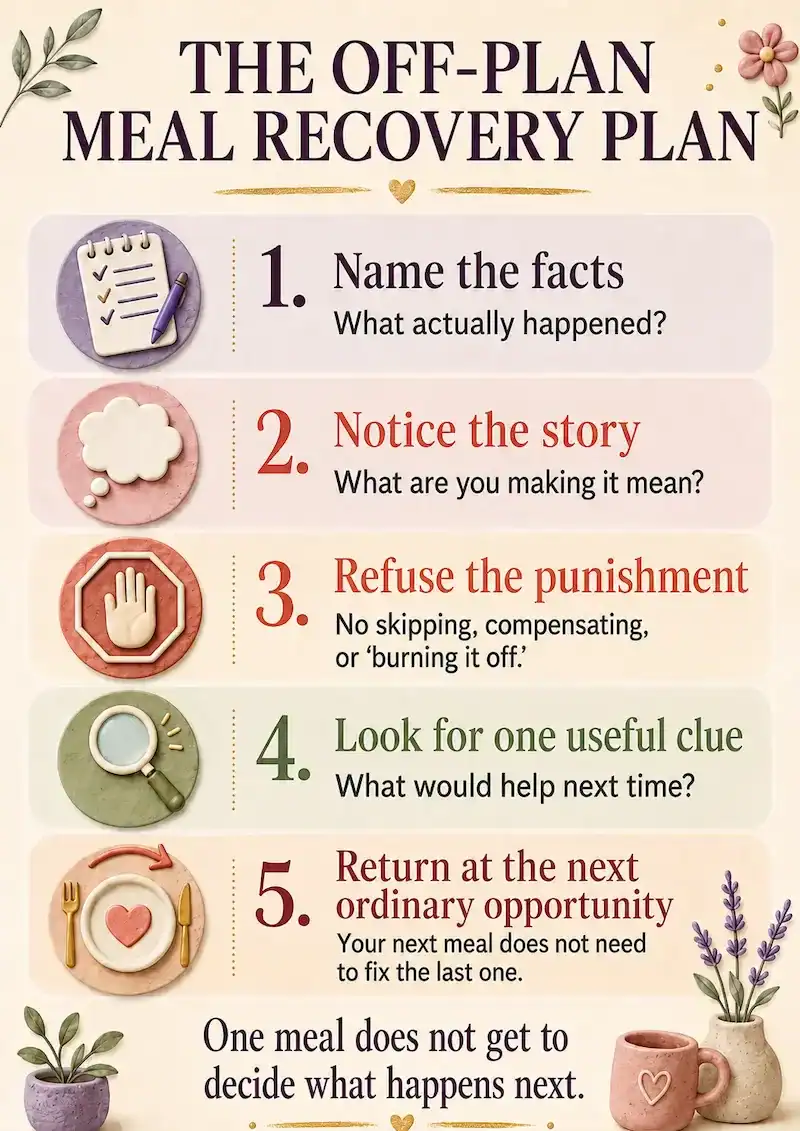
2. Notice the story
What are you making the meal mean?
“I always ruin everything.”
“I cannot trust myself.”
“I have no discipline.”
“This week is shot.”
Remember, a thought can feel familiar without being true.
3. Refuse the punishment
Don’t skip meals to make up for it.
Don’t exercise because you believe you need to erase what you ate.
Don’t create a harsher plan out of guilt.
4. Look for one useful clue
What, if anything, would help next time?
Maybe you need to arrive less hungry.
Maybe you want to slow down.
Maybe you want to catch the “might as well” thought sooner.
Choose one useful observation, not ten new rules.
5. Return at the next ordinary opportunity
Eat your next normal meal.
Take your normal walk.
Continue the habits that support you.
Don’t make the last choice responsible for the next one.
You Don’t Need to Start Over From a Life You Never Left
This might be the most important part.
You had one meal. You may have enjoyed it, but it was more than you wanted. Maybe there’s something useful to learn from it.
But you didn’t leave your life.
You didn’t erase every helpful choice you made before that meal, lose all your progress, or get kicked out of some imaginary healthy-living club until Monday. You’re already here, and the next choice is still available.
It doesn’t mean the last choice didn’t count, but it isn’t the only choice that counts.
An off-plan meal becomes much less powerful when you stop treating it like a verdict on who you are. You can tell the truth about what happened, learn something useful, make an adjustment, and continue.
No punishment. No grand reset. No lost week.
Just the next choice, made with a little more awareness than the one before it.
What Do You Usually Tell Yourself After an Off-Plan Meal?
Do you move on easily?
Do you feel like you need to make up for it?
Or does one meal sometimes turn into a whole weekend because you tell yourself you’ll start again Monday?
Pay attention to the first sentence that shows up.
That sentence may influence what happens next more than the meal itself.
And once you can hear it, you have a chance to choose a different response.
Want to remember this post? Pin this to your favorite Pinterest board!